< img height="1" width="1" style="display:none" src="https://www.facebook.com/tr?id=26825290190466607&ev=PageView&noscript=1" />

Nullam dignissim, ante scelerisque the is euismod fermentum odio sem semper the is erat, a feugiat leo urna eget eros. Duis Aenean a imperdiet risus.

How to Specify Cutters for 3D Glass Hot-Bending Graphite Molds

  • How to Specify Cutters for 3D Glass Hot-Bending Graphite Molds author
  • 19th November 2026

A mold drawing arrives with three awkward details: a broad cavity, a tiny internal radius, and a curved contact surface. One graphite cutter will struggle to do all three. Yet a purchase request that says only “diamond end mill for hot-bending mold” leaves those details out. The result may be a perfectly good cutter for the wrong feature.

Circle the smallest radius on the print. Beside it, write the feature depth, floor form and nearest wall. Check what shank the holder accepts. Only then split the job into roughing and detail work. This takes less time than discovering during programming that a selected tool cannot clear the wall.

How to Specify Cutters for 3D Glass Hot-Bending Graphite Molds

Separate roughing from the small features

Keep the small finishing cutter out of the heavy removal stage. An open area may take a larger roughing tool while narrow details wait for later passes. Leave known stock, though. A finishing tool should not discover an unexpected pocket at the bottom of a curved channel.

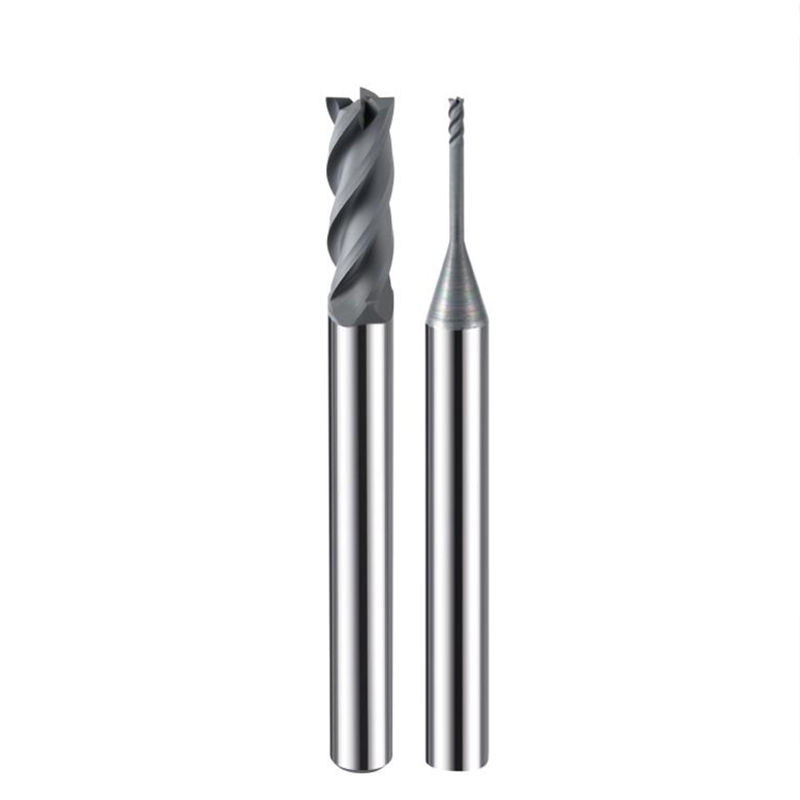
TSHZ lists a dedicated group of high-efficiency diamond-coated roughing tools. The flat roughing range includes a 4 mm, three-flute cutter with 12 mm flute length and 50 mm overall length. A 6 mm cutter appears with 20 mm flute length and 60 mm overall length in both three- and four-flute versions. Larger listed flat roughing diameters include 8, 10 and 12 mm. These are available catalogue dimensions; they do not prescribe a depth of cut or prove that a particular graphite grade can take a certain feed.

Curved areas complicate roughing. The same TSHZ range lists rough ball tools at 8 mm diameter/R4, 10 mm/R5 and 12 mm/R6. Their flute lengths are 30, 35 and 40 mm respectively. These larger tools can remove stock on an accessible curve. They cannot finish a corner smaller than their own geometry; that work remains for a separate detail tool.

Read radius and reach as separate requirements

A round-nose cutter for a specified corner

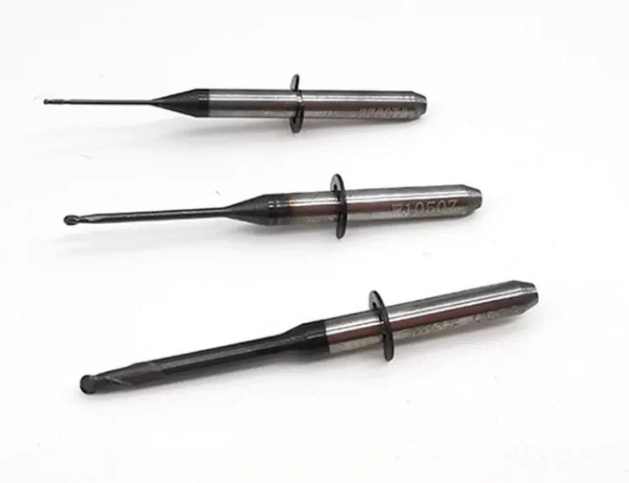
The corner radius belongs on the request, not in a later email. TSHZ’s 3D hot-bending graphite mold series includes round-nose cutters with a 1 mm cutting diameter and R0.1, R0.2 or R0.3 corners. One R0.1 version has 3 mm flute length, 6 mm effective cutting length, 50 mm overall length, a 4 mm shank and four flutes. A 2 mm/R0.5 version has 6 mm flute length and 10 mm effective cutting length, again with 50 mm overall length and a 4 mm shank.

The columns are easy to conflate. R is the corner form. Diameter tells whether the tool enters the feature at all. Flute length and effective cutting length are separate: a short cutting section can still sit on a relieved neck. Overall length matters to the holder setup. A familiar model code is no substitute for reading each column.

The TSHZ round-nose end mill is a sensible product page to include when a drawing requires a radiused corner with a relatively flat adjoining surface. Check the actual catalogue row and drawing together before treating a listed R value as an approved fit. The radius shown on a tool is not permission to alter a mold corner to match it.

A ball tool for the curved surface

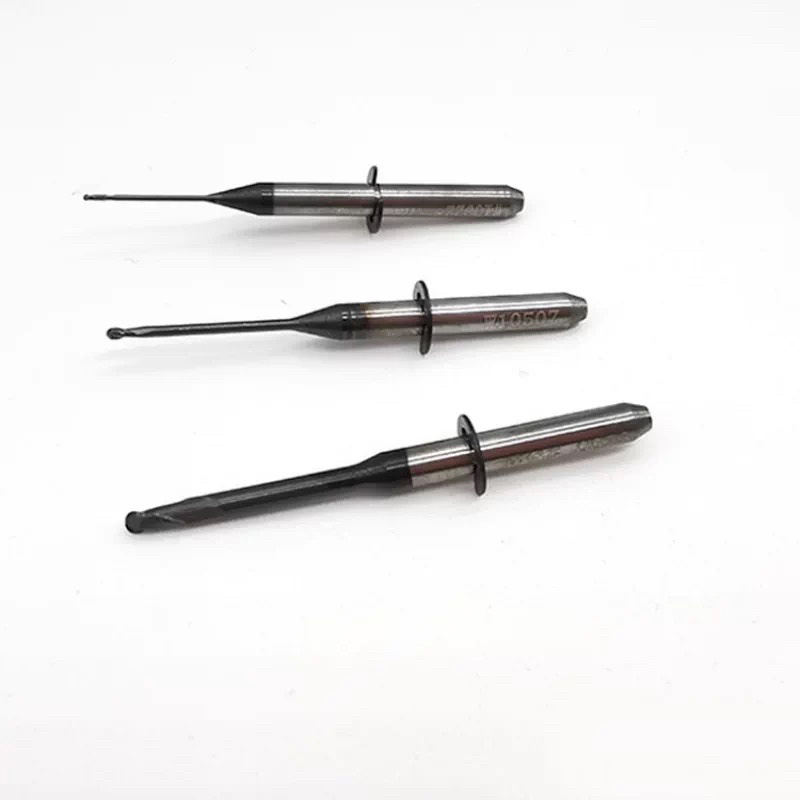
A ball tool follows a different contact geometry. In TSHZ’s hot-bending mold series, the 1 mm diameter/R0.5 ball tool is listed with effective cutting lengths of 2.5, 6 and 8 mm. The 1.5 mm/R0.75 and 2 mm/R1 versions include 8 mm effective cutting length. These GB-series ball tools have 50 mm overall length, 4 mm shanks and two flutes in the listed rows.

The 1 mm ball therefore has several reach choices, not one. Do not order the longest by default. Check where the shank might meet a wall and how far the tool must stick out of its holder. If the shorter version clears the feature, that may be the simpler trial setup.

The TSHZ ball-nose end mill page identifies complex 3D surface finishing as its application. A ball tool should be specified for that surface task, not ordered as a direct substitute for every round-nose or flat-floor operation. The company also lists a separate grinding-head option in the GB series, with D1.5/R0.75 and D2/R1 rows. That is a distinct tool form; confirm the actual process before adding one to an order.

How to Specify Cutters for 3D Glass Hot-Bending Graphite Molds

Keep the drawing and catalogue in the same unit system

The TSHZ tables identify cutting diameter, rounded corner where relevant, flute length, effective cutting length, overall length, nominal shank diameter and flute count. Copy those fields into the RFQ beside the drawing callouts. A dash under effective length needs a supplier answer; it does not mean “unlimited depth.”

An RFQ can be short and still useful: “round-nose, D1 mm, R0.1 mm, 6 mm effective cutting length, 4 mm shank; graphite hot-bending mold finishing.” Compare that with “small diamond mill.” The first can be checked against a catalogue row, then against the machine. A deeper wall may rule it out.

The broader TSHZ diamond and graphite cutting-tool series includes flat-bottom, round-nose and ball-nose forms. Match the specific form to the feature. A comparison of coated tool types in published research on high-speed milling of hot-bending graphite molds also treats corner geometry as a material part of the machining decision. Neither a catalogue nor a paper replaces a trial on the shop’s own grade and drawing.

Inspect a trial mold before fixing the tool list

For the trial, record graphite grade, cutter model, holder projection, extraction position and program version. Photograph the radius and curved surface at the same locations on each mold. Change one condition. If tool, path and extraction all change at once, the next good piece offers no clear explanation. Use the print’s acceptance limit to decide when the tool should leave production.

There are no universal feeds, speeds, finish values or tool-life guarantees in the cited TSHZ dimensional tables. Those values must be established for the actual material and machine. Avoid regrinding a diamond-coated cutter after it wears; removal of the coating exposes the carbide substrate and changes the tool being tested.

What to send with a tooling inquiry

TSHZ offers standard-size diamond-coated tools and non-standard customization. Send the mold drawing or a dimensioned extract, the intended graphite grade, the smallest R, feature depth, required floor and curved surfaces, holder/shank requirements, and the operation assigned to each tool. Include the current defect and photos if an existing process is failing.

Ask the supplier to identify the proposed catalogue row or explain which dimension needs a custom design. Then run a sample under recorded conditions before buying for production. This keeps a useful discussion about geometry from turning into a promise that one coated cutter can solve every roughing, corner and finishing problem on the mold.

Keep the reply with the drawing revision. If a radius changes between the sample and production prints, the tool list needs another review. The same applies when a fixture change forces more projection, even though the cutting diameter remains identical. Procurement should pass both changes to programming and inspection before ordering a repeat production batch.

Common specification questions

Does a 6 mm effective cutting length guarantee a 6 mm deep feature?

No. It is a catalogue tool dimension. Holder clearance, shank interference, toolpath and the surrounding mold walls still need checking.

Can the largest ball tool finish every curved feature?

No. The smallest specified radius and accessible geometry limit the tool choice. A larger tool may be useful earlier in stock removal while a smaller one handles the final detail.

When does a non-standard cutter make sense?

When the drawing’s combination of diameter, corner radius, reach and shank does not match an appropriate listed size. Provide those dimensions and the intended operation before requesting a design.
Tags:

Table of Contents

Frequently Asked Questions

"Price is what you pay, Cost is what you lose. A $15 tool that stops your $200k machine every 2 hours is the most expensive thing in your shop. Our CVD tool costs more because it buys you 40 hours of uninterrupted 'spindle-on' time. Which one saves you more by the end of the month?
I love skeptics—they usually become our best customers. In G5 Graphite or 18% Silicon Aluminum, standard carbide yields to abrasion in minutes. Our $8000 HV$ diamond crystalline layer literally ignores that abrasion. We don’t just claim it; we have the micro-wear test reports to back it up. Want to see the comparison video?
Stop right there. I’d love to sell you a tool, but Diamond and Iron are 'enemies' at high temperatures (chemical affinity). For steel, use our AlTiN series. But if you’re cutting Graphite, CFRP, or Ceramics, our CVD is the undisputed king. We sell solutions, not just metal.
That’s the difference between DLC (Diamond-Like Carbon) and True CVD. Most cheap 'diamond' tools are just thin films. Our CVD is chemically grown into the carbide substrate. It doesn't just sit on top; it's part of the tool. No peeling, just pure cutting.
Actually, it improves it. Because the diamond layer is ultra-smooth and the edge stays sharp 20x longer, you avoid the 'tearing' effect of a dull tool. You get a mirror-like finish on the 100th part just as you did on the 1st.
Don't sell them a tool; sell them 'Machine Capacity.' Tell your customers: 'Would you rather buy 1 tool and run all night, or buy 20 tools and pay someone to stand there and change them?' The labor savings alone pay for the tool.
"Diamond loves speed. High RPM is where it shines. We provide a customized cutting data sheet with every order. If you’re not sure, send us your material grade and we’ll calculate the optimal Vc and Fz for you. We don't just ship tools; we ship success."
We control coating thickness within $\pm 2\mu m$. In high-precision graphite electrode machining, we know microns matter. Our QC report for every batch ensures your offsets stay consistent from tool #1 to tool #100.
We stock standard sizes for immediate dispatch. We use DHL/FedEx—typically 4-7 days to your doorstep. We know a downed machine is a bleeding wound, and we’re here to stop the bleeding fast.
We offer 'Performance Guarantee' samples for qualified shops. We don't give them away for free because high-end tech has a cost, but if it doesn't outperform your current tool by at least 10X, the next one is on me. Fair enough?
A pure diamond film is "grown" onto the surface of a carbide substrate using chemical vapor deposition (CVD) technology. This film exhibits properties close to those of natural diamond, giving the tool exceptional hardness and wear resistance.
The hardness of a CVD diamond coating reaches up to 9000HV, making it one of the hardest tool coatings available in industry today.
When machining graphite materials, tool life typically increases by 3 to 18 times; in PCB processing, life extension can reach 20 to 30 times.
Graphite is highly abrasive and brittle, causing rapid wear on conventional tools. The high hardness of diamond coatings effectively resists wear and prevents chipping at the cutting edge.
4-flute: suitable for finishing or hard graphite, providing better surface finish. 2-flute: ideal for deep slotting or small-diameter tools (below D2), ensuring sufficient chip evacuation space and preventing tool breakage.
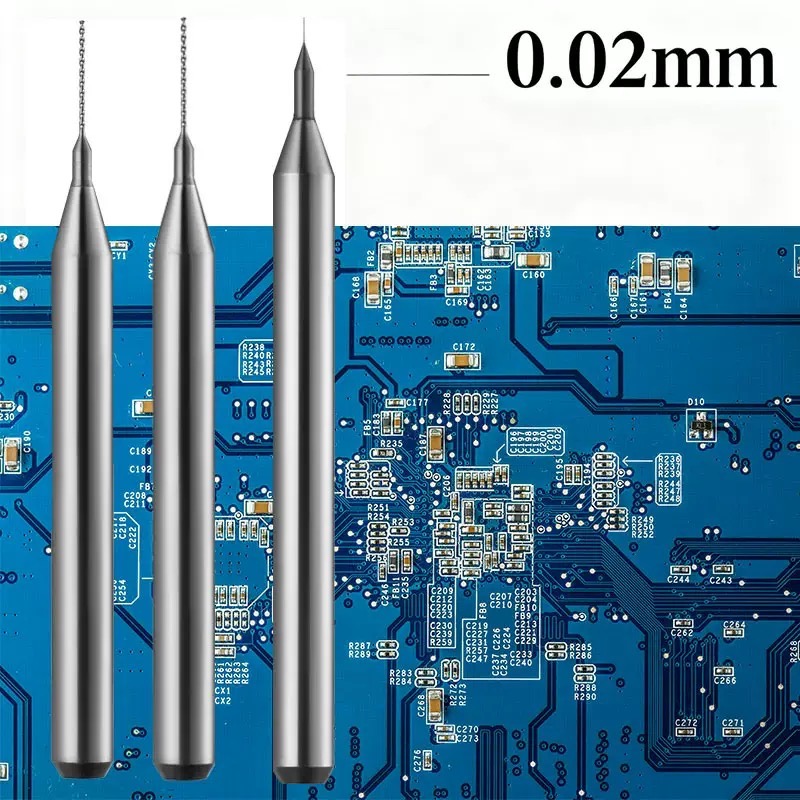
n principle, drill diameter = finished hole diameter – plating copper thickness compensation. A common recommendation is to add 0.03–0.05 mm compensation for finished hole diameters over 0.5 mm.
Whether machining graphite or PCBs, shorter overall lengths provide improved rigidity, reducing runout and minimizing the risk of tool breakage during operation.
This refers to deformation formed on the inner wall of a drilled hole due to drill wear or pulling action on the copper foil during retraction. Using CVD diamond-coated tools significantly reduces nail heads, improving hole wall quality.
Regrounding is not recommended. Reshaping would damage the diamond coating, exposing the lower-hardness substrate and drastically reducing performance.
Typically, replace the tool when hole wall quality deteriorates (e.g., burrs or nail heads exceeding 50 μm), visible edge wear under microscope, or when the processed quantity reaches 80–90% of the recommended tool life.
Although their unit price is typically 3–5 times higher than standard tungsten carbide tools, their extended lifespan results in a lower cost per hole, making them more economical in the long run.
High abrasiveness: The glass fibers in PCB materials are extremely hard and brittle, causing rapid wear of standard drill bits. Burrs and nail heads: Copper foil has high ductility, making it prone to burr formation at hole entrances or "nail head" defects when exiting, resulting in poor hole wall quality. Heat dissipation issues: Resin has low thermal conductivity; localized overheating can soften the tool.
Ultra-high wear resistance: Coating hardness reaches 9000HV, with a service life 20–30 times longer than conventional carbide drills. Reduced defects: Exceptionally sharp cutting edges significantly minimize burr and nail head formation. Thermal stability: Diamond has excellent thermal conductivity, enabling efficient heat dissipation and preventing resin burn on hole walls.
HDI/multilayer boards: Recommend TS-A01UC series, featuring a special UC flute design for superior chip evacuation, ideal for high-density micro-holes. Standard FR-4/CEM boards: Recommend TS-A02 ST standard series, offering the best cost-performance ratio. Large-diameter/thick boards: Recommend TS-A03 series, capable of drilling up to 6.50mm diameter with shank larger than drill diameter.
Exit burrs: Add a 0.3–0.5mm aluminum backing plate underneath the board and optimize retraction parameters. Entry burrs: Reduce feed rate during entry or switch to sharper diamond-coated drill bits.
Latest Product

Check out our Product

View More
PCB drilling bit

PCB diamond drill bit

PCB drill bits with excellent chip removal and hole roughness capabilities, long service life, suitable for drilling general multilayer and HDI boards, FR-4, CEM-1 boards, and eco-friendly boards. Diameter range: 0.1–3.175 mm,For the latest PCB boards, diamond-coated drills achieve over 3,000 holes per bit.
Read More
Diamond-coated PCB tool

PCB Diamond-Coated Milling Cutters

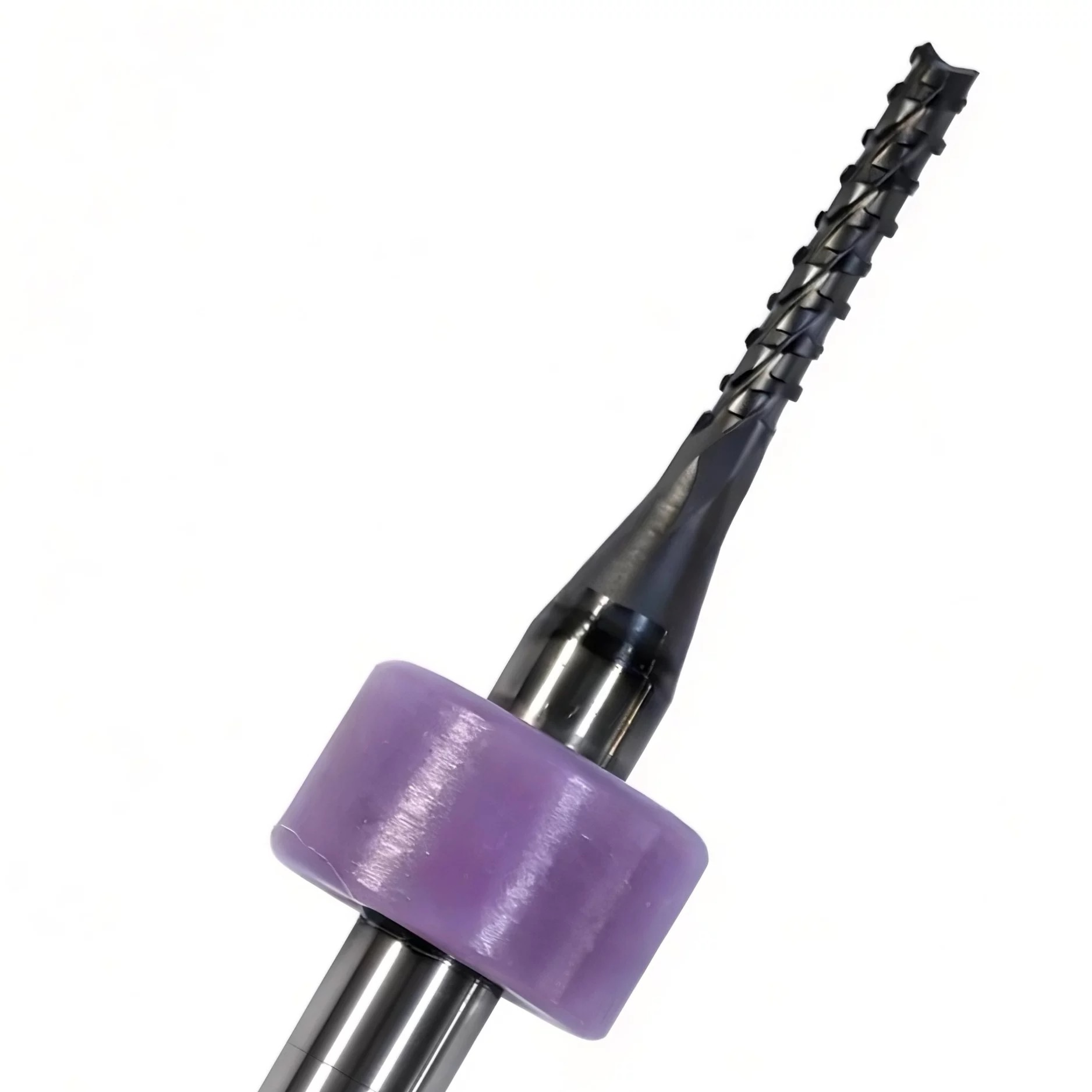
PCB diamond-coated milling cutters, also known as PCB routing cutters, printed circuit board milling cutters, or engraving cutters, are primarily used for contour cutting, slotting, depth-controlled milling, V-grooving, half-hole machining, and gold finger chamfering of PCBs; they are the most commonly used carbide tools in post-PCB manufacturing processes.
Read More
Dental-burs-1

CVD Diamond Dental burs

Micron-level precision cutting, balancing ultimate wear resistance with a gentle clinical experience,This series of dental burs features a high-purity integrated stainless steel/carbide substrate, coated with advanced CVD nano-diamond (or high-density natural diamond grit electroplating). Engineered for high-intensity clinical procedures such as tooth preparation, cavity access, decay removal, cosmetic restoration (veneer prep), and crown/bridge cutting. The ultra-hard, uniformly distributed diamond coating delivers aggressive cutting efficiency while minimizing frictional heat to protect the dental pulp, making it the premium choice for modern digital dentistry.
Read More
Flat-bottom-cylindrical-end-mill-1

Diamond coating Flat-bottom cylindrical end mill

Standard 2-flute/4-flute design with sharp cutting edges and large chip clearance space, suitable for efficient roughing and semi-finishing of graphite electrodes.
Read More
Get Standed
Is your tooling keeping up with the "Difficult-to-Machine" era?

Leave A Message

Graphite, Ceramics, and Carbon Fiber are the future, but they are “tool killers.” If you’re still using traditional coating, you’re fighting a losing battle.
Our CVD (Chemical Vapor Deposition) Diamond Coating creates a real crystalline diamond layer on the carbide substrate. This isn’t just a “finish”—it’s a shield.

Why top distributors choose our CVD series:
1.Ultra-Low Friction: Prevents chip welding and heat buildup.
2.Extreme Abrasion Resistance: Maintains sharp cutting edges $20 \times$ longer.
3.Surface Finish: Mirror-like results on the workpiece, zero secondary polishing needed.


    Your Name*

    Email

    Tel

    WhatsApp*

    Message

    Products
    Contacts
    WhatsApp
    Email